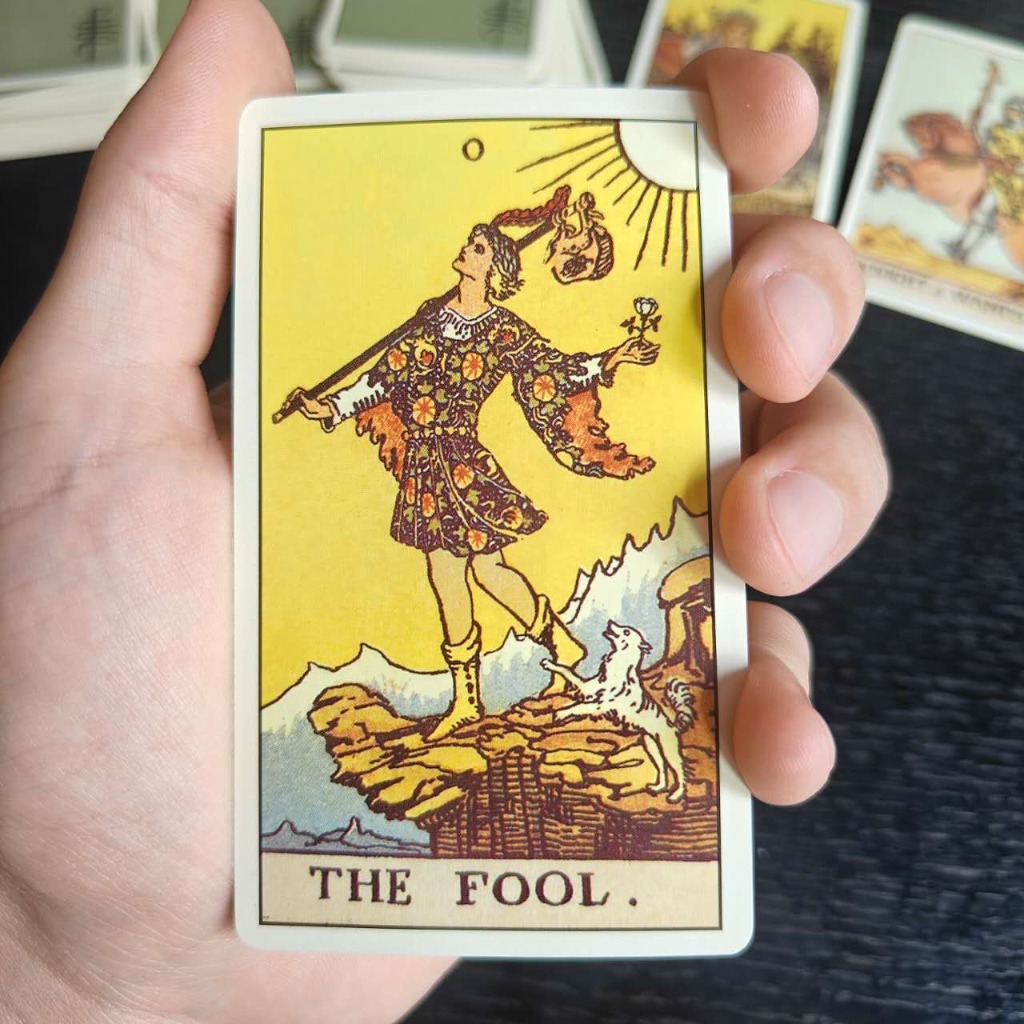

The most common mistake beginners make with tarot is treating it as a memory test — 78 cards, each with a fixed meaning, to be memorized like flashcards. That approach produces two outcomes: people who give up, and readers who recite dictionary definitions without understanding what they are looking at.
The cards are not a list; they are a language. The deck is built on a structure so consistent that once you understand the grammar, you can interpret any card you have never seen before. This guide teaches you that grammar: the 22 Major Arcana, the four suits, the numbers, the court cards, and how everything shifts in context. It is the same framework the best readers I have tested work from — and the difference between reciting meanings and actually reading.
The Structure: Why 78 Cards, and How They Fit Together
A tarot deck divides into two halves with completely different jobs.
The Major Arcana is 22 cards, numbered 0 through 21, from The Fool to The World. These are the big themes — the archetypal life events and transitions. When a Major card appears in a spread, the situation matters beyond the immediate question; it is a chapter of your story, not a paragraph.
The Minor Arcana is 56 cards divided into four suits of 14: Wands, Cups, Swords, and Pentacles. These are the everyday events, the details and dynamics that make up normal life. The suit tells you the domain; the number tells you the stage.
Every card is one intersection of “which domain” and “what stage” — and that intersection is the meaning.
The Four Suits: The Domain of the Card
The suits map onto both the elements and the domains of life, and this single mapping unlocks the entire Minor Arcana.
Wands — Fire — action and passion. Wands cards concern energy, ambition, creativity, and the things you are actively building or pursuing. Where there is drive, desire, or a project in motion, there are Wands.
Cups — Water — emotion and connection. Cups cards concern feelings, relationships, intuition, and the inner world. Love, grief, joy, and the bonds between people all live in Cups.
Swords — Air — thought and conflict. Swords cards concern the mind: decisions, communication, worries, and the battles we fight with ourselves and others. Swords are the sharpest and often the hardest suit, because they deal in truth and consequences.
Pentacles — Earth — material and practical. Pentacles cards concern the body, money, work, health, and everything tangible. Home, career, finances, and the slow work of building a life are Pentacles territory.
Once you know the suit, you know what the card is about. The number tells you the rest.
The Numbers: The Stage of the Story
The numbered cards (Ace through Ten) follow a sequence that is consistent across all four suits. Learn it once, apply it four times.
Ace — a seed. A new beginning, an opportunity, the first spark of the suit’s energy.
Two — a choice. A crossroads, a balance to strike, the first tension between two options.
Three — growth. The first real results, expansion, the moment the seed shows growth.
Four — stability. A settled state — which can be security or stagnation, depending on the suit.
Five — conflict. Disruption, loss, the friction that forces change.
Six — harmony. A return to balance, cooperation, a smoother stretch.
Seven — assessment. A pause to evaluate, a challenge to what has been built, a decision about worth.
Eight — momentum. Movement, speed, and often effort — the Eight of Wands flies, the Eight of Swords binds.
Nine — near completion. Almost there — the culmination before the end, often with a note of reflection or anxiety.
Ten — completion. The end of the suit’s cycle — a full story finished, for good or ill.
So the Three of Wands is “action at the growth stage” — a project expanding. The Eight of Cups is “emotion leaving” — walking away from a draining situation. The structure does the work; the imagery confirms it.
The Court Cards: People and Parts of Yourself
The four court cards in each suit represent either actual people or aspects of the querent’s own personality.
Pages — the student. Learning, curiosity, the beginning of mastery. A Page often signals news or a new development.
Knights — the mover. Action, pursuit, intensity. Knights charge; they are rarely still.
Queens — the master of the inner realm. The Queen of Wands is charisma, the Queen of Cups is emotional depth, the Queen of Swords is clarity, the Queen of Pentacles is grounded care.
Kings — the master of the outer realm. The King of Wands is vision and leadership, the King of Cups is emotional maturity, the King of Swords is authority and intellect, the King of Pentacles is wealth and security.
In a reading, a court card can be a person in your life, yourself, or a quality you need to embody. Context decides.
The Major Arcana: The 22 Life Themes
The Major Arcana are the archetypes, and the 22-card sequence is itself a story — the Fool’s journey from innocence through experience to completion. The meanings in brief:
0 The Fool — beginnings, faith, the leap. I The Magician — will, resourcefulness, “you have what you need.” II The High Priestess — intuition, hidden knowledge. III The Empress — nurture, abundance, creativity. IV The Emperor — structure, authority. V The Hierophant — tradition, guidance, systems. VI The Lovers — choice, alignment, connection. VII The Chariot — willpower, momentum. VIII Strength — quiet courage. IX The Hermit — solitude, seeking. X Wheel of Fortune — change, cycles, fate. XI Justice — fairness, truth, cause and effect. XII The Hanged Man — surrender, pause, new perspective. XIII Death — transformation, endings that enable beginnings. XIV Temperance — balance, patience. XV The Devil — attachment, bondage. XVI The Tower — sudden upheaval, revealed truth. XVII The Star — hope, healing. XVIII The Moon — illusion, uncertainty. XIX The Sun — joy, success, clarity. XX Judgement — reckoning, a call to rise. XXI The World — completion, wholeness.
Reversals: The Shadow and the Blocked
A reversed card is not the opposite of the card; it is the card with its flow impeded. Three common readings: the energy is blocked (the chariot stalled), internalized (the queen turned inward), or delayed (the tower’s change coming later). Reversals point to what needs attention — and in the hands of a skilled reader, they are often the most informative cards in the spread, because they show where the friction is.
Where to Go From Here
The grammar in this guide is enough to interpret any card in any spread — and it is also the foundation professional readers build on. The difference between a tarot interpretation and a tarot reading is the intuitive layer: what the cards mean is structured, but what they mean for you, right now requires context. That is where a live reader adds value beyond the deck.
If you want a personal reading, the readers I have tested on Keen and Kasamba include experienced tarot practitioners who can take your question further than a guide ever could — and my review of Tarot by Elena documents what a skilled card-by-card reader looks like in practice. My guide on questions to ask a psychic will help you get the most from the session.
A ranking of the six best tarot readers on Kasamba in 2026, built on tarot's structural advantage — every claim is anchored to a card you can look up. Includes a reader whose client kept a five-year prediction log, Kasamba's own former horoscope writer, and the fastest draw on the platform.
Read the guide →Ready to Try a Reading?
I've personally tested every major platform. Here are my top picks for 2026 — with free introductory minutes so you can try risk-free.
Still weighing it up? The fastest way to know if a reading clicks is to try one — 3 free minutes + 50% off for new clients.
Free to join · 3 free minutes with each new advisor · No subscription
Ready to get your reading?
I’ve personally tested each platform with my own money. Pick the one that fits your question — every link is an independent recommendation.
3 free minutes + 50% off
Permanent chat transcripts & 3 free minutes with every new advisor — safest for testing relationship specialists.
Claim 3 Free Min + 50% Off →
$30 credit on first purchase
Mandatory video intros & a public outcomes ledger. The most accessible entry price.
Claim $30 Credit →
5 minutes for $1
Deepest roster & finest phone infrastructure. The safest place to test a top reader for pocket change.
Get 5 Min for $1 →Eastern Alignment is reader-supported. If you sign up through a link, we may earn a commission — at no extra cost to you. This never influences my ratings.